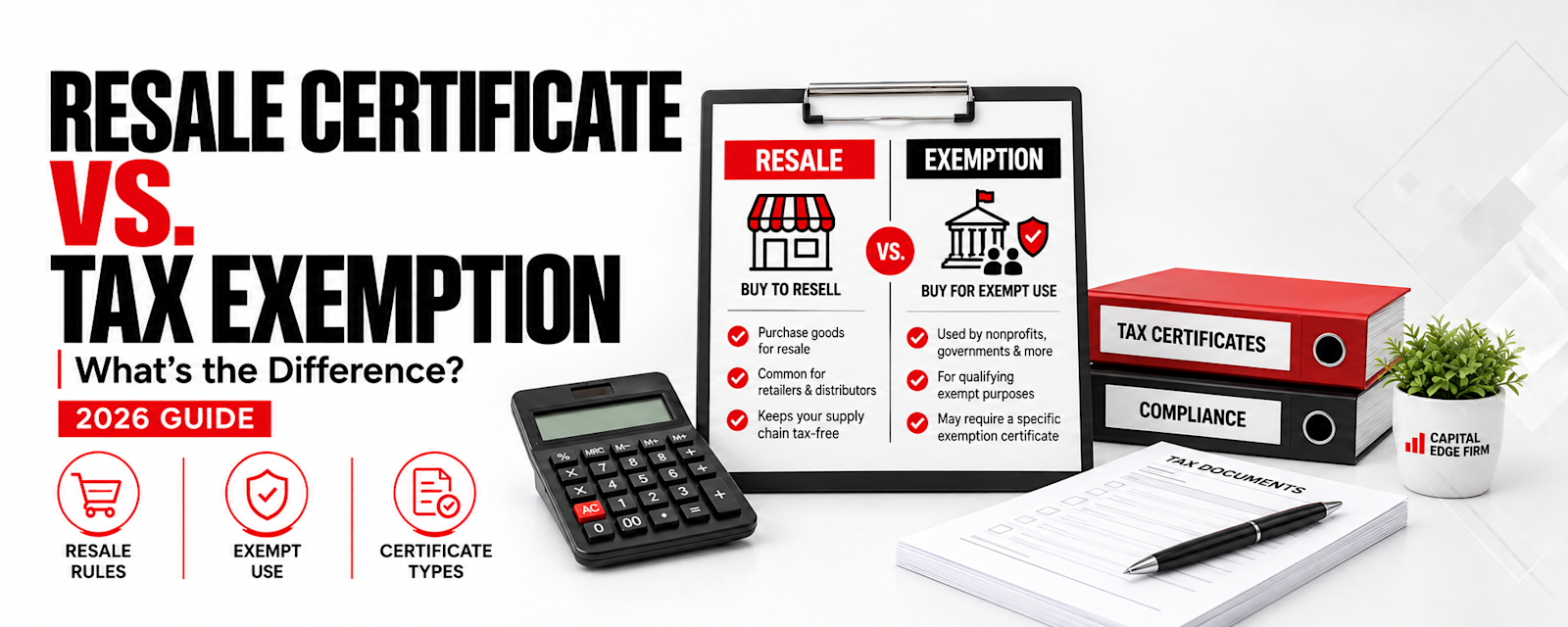
Businesses frequently use the terms resale certificate, tax-exempt certificate, sales tax exemption certificate, seller's permit, and sales tax permit as though they all mean the same thing.
They do not.
And confusing them can create problems for both sides of a transaction.
A purchaser may give a vendor the wrong document and still be charged sales tax.
A seller may accept documentation that does not support the claimed exemption and later discover the problem during an audit.
A nonprofit may assume its federal 501(c)(3) determination automatically makes every purchase exempt from state sales tax.
A retailer may show a supplier its sales tax permit even though the state requires a completed resale certificate.
The easiest way to understand the issue is this: A resale certificate is generally one type of sales tax exemption certificate. But not every sales tax exemption certificate is a resale certificate.
New York makes this especially clear. Its current Form ST-120 instructions state that its Resale Certificate is a sales tax exemption certificate, while the state maintains separate exemption documents for exempt organizations, exempt uses, contractors, agricultural purchases and numerous other situations.
Understanding the reason for the exemption is therefore more important than simply asking:
“Do you have a tax-exempt certificate?”
Quick Answer: Resale Certificate vs. Exemption Certificate
The distinction can be summarized this way:
Question | Resale Certificate | Other Sales Tax Exemption Certificate |
Why is tax not being charged? | Property or qualifying service is being purchased for resale | Purchaser, product, use, organization, industry or another statutory reason qualifies |
Typical purchaser | Retailer, wholesaler, manufacturer or reseller | Nonprofit, government entity, manufacturer, farmer, contractor or other qualifying purchaser |
Will purchaser normally resell the item? | Yes | Not necessarily |
Is seller's permit/registration often relevant? | Yes | Depends on the exemption |
Does nonprofit status create it? | No | It may support a separate exemption, depending on state law |
Is it the same document in every state? | No | No |
Does the seller normally retain it? | Yes | Generally yes |
Does it automatically make every purchase tax-free? | No | No |
The correct document depends on why the transaction is exempt.
What Is a Resale Certificate?
A resale certificate documents that a purchaser is acquiring property or qualifying services for resale rather than for its own use or consumption.
Consider a simple retail chain: Manufacturer → Wholesaler → Retailer → Consumer
Suppose the retailer purchases merchandise from the wholesaler for: $20,000 and eventually sells that inventory to consumers for: $32,000
The retailer's purchase from the wholesaler is generally a wholesale transaction made for resale.
The retailer may provide appropriate resale documentation so the supplier does not collect sales tax on the $20,000 inventory purchase.
Later, when the retailer sells the product to the final customer, applicable sales tax can be collected on the retail transaction.
The resale exemption helps prevent the merchandise from being taxed as though both stages were final consumption.
A Resale Certificate Is Based on What Will Happen to the Purchase
The crucial factor is generally the intended resale of the property.
California's official guidance explains that resale certificates are used when purchasing finished goods for resale, materials that become a physical part of a product held for resale, and certain items held solely for demonstration or display while remaining for sale.
A resale certificate should generally not be used merely because the purchaser is a retailer.
For example, a furniture store may properly buy 100 dining chairs for resale without paying tax when the transaction qualifies. But the same furniture store cannot automatically use its resale certificate to buy:
Computers for Accounting
Cleaning products
Office supplies
Tools
Desks used by employees
Furniture for its own conference room
Those items are being used by the business, not resold to customers.
What Is a Sales Tax Exemption Certificate?
A sales tax exemption certificate is a broader concept. It documents why a transaction that might otherwise be taxable qualifies for an exemption under applicable state law.
The reason does not have to be resale. Potential exemption categories can include:
Resale
Government purchases
Qualifying nonprofit organizations
Manufacturing
Agriculture
Industrial production
Exempt use
Certain contractors or construction transactions
Research and development
Medical or healthcare exemptions
Specific products
Diplomatic purchases
Other exemptions created by state law
New York's current exemption-document list demonstrates the breadth of the concept. In addition to its ST-120 Resale Certificate, the state has separate certificates for exempt organizations, contractors, exempt use, tractors and trailers, promotional materials, computer-system hardware, textbooks, farmers and other transactions.
Therefore resale is one exemption reason. It is not the only one.
Resale Certificate vs. Exempt Organization Certificate
This distinction causes particularly frequent confusion.
A retailer buying inventory and a charitable organization buying supplies may both make purchases without sales tax. But they may be doing so for completely different legal reasons.
Retailer
The retailer says:
“Do not charge sales tax because I am buying this product to resell it.”
That is a resale exemption.
Exempt Organization
The qualifying organization may say:
“Do not charge sales tax because state law grants qualifying purchases by our organization an exemption.”
That is an organization-based exemption. The organization may have no intention of reselling the property. It may consume the property itself.
501(c)(3) Does Not Automatically Mean State Sales Tax Exempt
This is one of the most important concepts for nonprofits.
Federal income tax exemption and state sales tax exemption are different.
A determination from the IRS under Internal Revenue Code Section 501(c)(3) does not by itself create the same sales tax treatment in every state.
Florida provides a good example. Qualifying nonprofit organizations must obtain a Florida Consumer's Certificate of Exemption — Form DR-14 from the Florida Department of Revenue to make qualifying exempt purchases under Florida law. Florida generally issues these certificates for five-year periods.
New York also generally requires qualifying nonprofit organizations to apply for New York State sales tax exempt status. If approved, the organization receives state exemption documentation and uses the appropriate exempt purchase certificate. New York specifically notes that a federal EIN is not the organization's New York sales tax exemption number.
So a vendor should not simply see 501(c)(3) and conclude no sales tax. State requirements must be reviewed.
Florida: Annual Resale Certificate vs. Consumer's Certificate of Exemption
Florida provides one of the clearest real-world examples of the difference.
Florida Annual Resale Certificate for Sales Tax
Florida issues an Annual Resale Certificate for Sales Tax to qualifying businesses registered to collect sales tax. It allows qualifying property or services to be purchased tax-free when they will be resold or re-rented. It expires every December 31 and is reissued annually to qualifying active dealers.
Florida Consumer's Certificate of Exemption
This is a different document. Florida issues the Consumer's Certificate of Exemption — Form DR-14 to qualifying exempt organizations and governmental entities under Florida law. These certificates answer different questions:
Annual Resale Certificate: Will the purchaser resell or re-rent the property?
Consumer's Certificate of Exemption: Does the purchaser itself qualify for an exemption under Florida law?
The words “certificate” and “tax exempt” appear in both contexts. The underlying legal reason is completely different.
Florida Example
Imagine two customers walk into the same office-supply store.
Customer A — Retailer
A retailer purchases 50 calculators to sell in its stores. It presents its current Florida Annual Resale Certificate.
Potential result: Purchase for resale → qualifying resale exemption.
Customer B — Qualifying Nonprofit
A qualifying charitable organization buys 50 calculators for use by students in its nonprofit program. It is not reselling them. Instead, it presents its valid Florida Consumer's Certificate of Exemption and pays using the organization's funds as required by Florida's rules.
Potential result: Organization/use exemption → qualifying exempt purchase.
Both purchases may occur without sales tax. But they are not the same exemption.
New York: One State, Many Different Exemption Documents
New York illustrates why the phrase “tax-exempt certificate” can be dangerously vague. Current New York documents include:
ST-120 — Resale Certificate
ST-119.1 — Exempt Organization Exempt Purchase Certificate
ST-121 — Exempt Use Certificate
ST-120.1 — Contractor Exempt Purchase Certificate
ST-125 — Farmer's and Commercial Horse Boarding Operator's Exemption Certificate
Specialized certificates for promotional materials, certain computer hardware, textbooks and additional transactions
If a customer tells a New York seller:
“We're tax exempt.”
that statement is incomplete.
The seller needs to know: Why?
Texas: Resale and Exemption on the Same Form
Texas shows why the terminology can become even more confusing.
Texas Form 01-339 contains:
Texas Sales and Use Tax Resale Certificate
Texas Sales and Use Tax Exemption Certification
on the same overall form. But the two certifications are not conceptually identical.
Resale
The purchaser is buying a taxable item for resale. Texas specifically warns that a purchaser's sales tax permit number or copy of its permit does not substitute for a properly completed resale certificate.
Other Exemption
The purchaser claims another qualifying exemption. Texas guidance explains that exemption certificates can apply, for example, to exempt organizations and certain property qualifying for statutory exemptions.
Same PDF. Different legal reasons.
Resale Certificate vs. Sales Tax Permit
Another common mistake is confusing these documents.
Sales Tax Permit
A sales tax permit or registration generally establishes the business's account with the state taxing authority. It may create obligations to:
Collect tax
File sales tax returns
Remit tax
Maintain records
Renew or update registration
Report taxable and exempt sales
Resale Certificate
The resale certificate is generally provided to the supplier to document a purchase for resale.
Think of it this way:
Sales Tax Permit → State
Resale Certificate → Vendor
This is simplified, because states use different terminology, but it captures the operational difference.
Our How to Get a Resale Certificate in Every State: 2026 Guide explains the registration and documentation process across all 50 states and Washington, D.C.
Resale Certificate vs. EIN
An EIN is another completely different number. The Employer Identification Number is issued at the federal level. It is used for federal tax identification and numerous banking, payroll and business purposes.
It does not automatically function as:
A state sales tax permit
A resale certificate
A state exemption number
Proof that purchases are sales-tax exempt
New York, for example, specifically explains that the federal EIN issued by the IRS is not the organization's New York State sales tax exemption number.
Exempt Purchaser vs. Exempt Product vs. Exempt Use
Another powerful way to understand sales tax exemptions is to ask: What exactly is exempt?
There are three broad possibilities.
The Purchaser May Be Exempt
Examples can include qualifying:
Government entities
Charitable organizations
Religious organizations
Educational organizations
depending on state law.
The Product May Be Exempt
Certain products can be exempt regardless of who buys them. Depending on the state, examples can include certain:
Grocery food
Prescription medications
Medical products
Manufacturing machinery
Agricultural products
In some cases, no certificate is needed because the product is statutorily exempt by its nature.
The Use May Be Exempt
A normally taxable item can sometimes qualify because of how it will be used. Examples can include:
Manufacturing
Agricultural production
Research
Industrial processing
Incorporation into another product
Certain construction or government projects
This is why a generic statement such as:
“We are tax exempt.”
does not give the seller enough information.
Does an Exempt Organization Pay Sales Tax on Everything It Buys?
Not necessarily exempt from everything. Even when an organization qualifies for state sales tax exemption, restrictions can apply to:
Who makes the purchase
Whose funds are used
Whether the purchase serves the organization's exempt purpose
Type of property
Type of service
Location
Accommodation
Vehicle
Contractor purchase
Personal reimbursement
Other state-specific conditions
Florida, for example, generally requires qualifying exempt purchases to be paid with the organization's funds; personal payment by an authorized representative followed by reimbursement can still result in a taxable purchase. Exempt organization status should therefore never be treated as unlimited tax-free shopping.
Can an Exempt Organization Also Make a Resale Purchase?
Yes, potentially. The concepts can overlap. Imagine a qualifying nonprofit operates a museum gift shop.
The organization purchases educational books to distribute free in its program and separately purchases souvenirs to sell in its gift shop.
The first transaction might potentially rely on an organization-based exemption where state law permits. The merchandise acquired for the gift shop may instead involve a resale transaction. The same legal entity can therefore encounter different exemption reasons for different purchases.
That is why accounting systems should classify the transaction—not merely the customer.
Can a Business Use a Resale Certificate for Manufacturing?
Sometimes the purchase may qualify as a sale for resale when materials become an ingredient or component of a finished product that will itself be sold. But manufacturing also has its own state-specific exemptions.
For example:
Wood incorporated into furniture being manufactured for sale may potentially qualify through resale/component treatment.
But:
Machinery used to manufacture that furniture may depend on a separate manufacturing exemption rather than a resale certificate.
These should not automatically be treated as the same transaction.
Exemption Certificate vs. Direct Pay Permit
There is another category businesses sometimes encounter: Direct Pay or Direct Payment Permits.
A direct-pay arrangement generally allows an authorized purchaser to buy qualifying property without paying sales tax to the vendor and then determine and remit the applicable tax directly to the state.
That is not the same as claiming “This purchase is exempt.”
It often means “The purchaser will determine the tax treatment and remit applicable tax directly.”
Businesses handling these certificates should avoid classifying every direct-pay transaction as a resale or exemption transaction.
Why the Seller Cares So Much About the Certificate
From the customer's perspective, the certificate may look like paperwork needed to remove sales tax from an invoice. From the seller's perspective, it is audit evidence.
Texas explains this clearly: the resale certificate is the seller's evidence of why sales tax was not collected, and the seller must retain the documentation according to state recordkeeping rules.
The Multistate Tax Commission similarly explains that sellers accepting qualifying certificates should retain them under applicable state law.
This is why vendors may refuse:
Incomplete certificates
Expired certificates
Incorrect state forms
Invalid registration numbers
Certificates inconsistent with the transaction
Documents that do not match the customer's business
Certificates claiming the wrong exemption reason
The vendor is not simply being difficult. The vendor may be the party assessed during an audit.
Good Faith Matters
Many state systems protect sellers that accept properly completed exemption documentation in good faith. The Multistate Tax Compact recognizes reliance on resale or other exemption documentation accepted in good faith under applicable state rules.
But “good faith” does not necessarily mean:
“The customer handed us a PDF, so we stopped asking questions.”
The seller should review whether the claimed exemption makes reasonable sense.
For example:
A clothing retailer buying 5,000 shirts for resale makes intuitive sense. The same retailer presenting a resale certificate to buy a commercial refrigerator for its employee break room should trigger additional review.
Who Completes the Certificate?
Generally the purchaser claims the exemption.
The purchaser provides the appropriate documentation to the seller.
The seller reviews and retains it.
Streamlined Sales Tax specifically instructs purchasers to provide completed exemption certificates to their supplier and retain a copy; the certificate should not simply be sent to the Streamlined Governing Board or states.
Single-Purchase vs. Blanket Certificates
Some states permit exemption documentation to cover one transaction while other documentation may operate as a blanket certificate for recurring qualifying transactions.
A blanket certificate reduces administrative work. But it does not change what qualifies. Suppose a wholesaler has a blanket resale certificate from a retailer.
Purchase 1
500 products for retail sale. Potentially covered.
Purchase 2
One laptop for the retailer's Accounts Payable department. Not automatically exempt merely because a blanket certificate is already on file.
The nature of the purchase still controls.
Multistate Resale and Exemption Certificates
Businesses operating in multiple states may encounter standardized certificates.
MTC Uniform Sales & Use Tax Resale Certificate
The Multistate Tax Commission currently identifies 36 states that have indicated its Uniform Sales & Use Tax Resale Certificate can be used as a resale certificate, subject to state-specific instructions and limitations. The current official form remains the October 14, 2022 revision. MTC warns that individual state requirements can change and should be confirmed with the applicable state.
Streamlined Sales Tax Certificate of Exemption
The Streamlined Sales Tax Certificate of Exemption is accepted by all 24 Streamlined member states.
Importantly, despite the name Certificate of Exemption, the form can be used for different qualifying exemption reasons, including resale when state requirements are met.
This demonstrates the core concept of this entire article: “Exemption certificate” is the broader category. “Resale” is one exemption reason.
Marketplace Sellers Still Need to Understand the Difference
Selling through:
Amazon
Etsy
eBay
Walmart
does not eliminate this issue. A marketplace facilitator may collect sales tax on the seller's customer transaction. But the marketplace seller may separately buy inventory from a supplier.
Those are two different transactions: Supplier → Marketplace Seller and Marketplace Seller → Customer
The first transaction may require resale documentation even when Amazon or another marketplace handles tax on the second transaction.
Our Marketplace Facilitator Sales Tax: Amazon, Etsy, eBay & Walmart Explained (2026) guide explains the marketplace side in detail.
Drop Shipping Makes the Certificate Question Even More Important
Drop shipping introduces Supplier → Retailer → Customer while the supplier ships directly to the customer. The retailer may need to provide resale documentation to its supplier. But the correct certificate can depend on:
Destination state
Retailer's registrations
Supplier's nexus
State-specific drop shipment rules
MTC acceptance
Streamlined Sales Tax rules
The retailer cannot simply assume that its home-state certificate works everywhere. Our Drop Shipping Sales Tax by State: Complete Guide for Sellers (2026) explains those three-party transactions in detail.
What If the Customer Gives the Wrong Certificate?
Suppose a customer says:
“We're tax exempt.”
The seller receives a document. But the document proves that the customer is a reseller, while the customer is buying equipment for its own office.
The existence of a real resale certificate does not automatically make the purchase exempt. Similarly, a nonprofit exemption certificate may not support an inventory resale claim if the exemption and transaction do not match.
The seller should determine:
Who is the purchaser?
What is being purchased?
Why is exemption claimed?
Does that state recognize the exemption?
Is this the correct certificate?
Is the certificate complete?
Is registration or exemption status current?
Does the purchase reasonably fit the exemption?
Is additional documentation required?
How long must the certificate be retained?
What If Sales Tax Was Already Charged?
Receiving a valid certificate after the sale does not automatically answer what the seller should do next. A business may need to determine:
Was the transaction actually exempt?
Was the certificate timely?
Has the tax already been remitted?
Can the seller issue a credit or refund?
Is an amended return required?
Must the purchaser file directly with the state?
What records should be retained?
For that process, see our Can You Refund Sales Tax After a Customer Provides a Resale Certificate? 2026 Guide.
How Sellers Should Classify Exemption Documentation
Instead of creating one folder labeled TAX EXEMPT consider categorizing certificates by reason.
For example:
RESALE
EXEMPT ORGANIZATION
GOVERNMENT
MANUFACTURING
AGRICULTURE
EXEMPT USE
DIRECT PAY
CONTRACTOR
OTHER STATUTORY EXEMPTION
Then track:
Customer
State
Certificate type
Registration/exemption number
Effective date
Expiration date
Blanket vs. single-use
Products covered
Verification date
Supporting documentation
Renewal requirement
That system is substantially easier to defend during an audit than a folder filled with unidentified PDFs.
Common Mistakes
Calling every tax-exempt document a resale certificate.
Calling every resale certificate an exempt organization certificate.
Using a sales tax permit instead of the actual certificate required by the state.
Using an EIN as though it were a state exemption number.
Assuming 501(c)(3) automatically creates state sales tax exemption.
Using resale documentation to buy property that the business will consume.
Accepting a nonprofit certificate for an employee's personal purchase.
Failing to determine whether organizational funds must be used.
Assuming the same form works in every state.
Accepting an expired certificate.
Ignoring the product or exempt-use requirements.
Treating MTC or SST forms as universally accepted without reviewing state instructions.
Failing to distinguish blanket certificates from unlimited exemptions.
Keeping certificates without verifying what exemption they actually support.
Resale vs. Exemption Decision Tree
When a customer asks:
“Can you remove sales tax?”
start here.
Question 1 — Is the customer purchasing the property for resale?
Yes → Review resale certificate requirements.
No → Continue.
Question 2 — Is the purchaser itself exempt under state law?
Examples:
Government entity
Qualifying nonprofit
Religious organization
Educational institution
Yes → Review entity-based exemption documentation.
No → Continue.
Question 3 — Is the product itself exempt?
Yes → Determine whether documentation is required.
No → Continue.
Question 4 — Is the product being purchased for an exempt use?
Examples can include manufacturing, agriculture or another qualifying activity.
Yes → Obtain the appropriate use-based exemption documentation.
No → The transaction may be taxable unless another exemption applies.
That simple decision tree solves much of the terminology problem.
Purchaser Checklist
Before giving a vendor any tax-exemption document:
Identify why the purchase should be exempt.
Confirm whether it is actually for resale.
Confirm the destination state.
Determine whether state registration is required.
Use the correct current form.
Provide the correct state ID or exemption number.
Describe the qualifying property accurately.
Confirm who may sign.
Confirm whether the certificate can be blanket or single-use.
Track expiration.
Update vendors when information changes.
Pay use tax when resale inventory is withdrawn for business or personal use where required.
Seller Checklist
Before removing sales tax from a transaction:
Identify the exemption reason.
Obtain the correct certificate.
Confirm purchaser name.
Confirm applicable state.
Confirm registration or exemption number when required.
Check expiration.
Verify current status when a state verification system exists.
Confirm the products reasonably match the claimed exemption.
Distinguish resale from exempt use.
Distinguish exempt organization status from resale.
Determine whether the certificate is single-use or blanket.
Save the documentation.
Track renewals.
Document verification.
Make the records easy to retrieve during an audit.
For state-by-state verification procedures, see our How to Verify a Resale Certificate in Every State: 2026 Guide.
Final Takeaway
The most useful rule to remember is: Every resale certificate supports a tax-exemption claim, but not every sales tax exemption certificate supports a resale transaction.
A resale certificate generally answers:
“Why aren't we paying sales tax?”
Because:
“We are buying this property for resale.”
Another exemption certificate might answer:
“Why aren't we paying sales tax?”
Because:
“We are a qualifying exempt organization.”
or:
“This property will be used in qualifying manufacturing.”
or:
“This is an exempt government purchase.”
or:
“State law exempts this specific use or product.”
The tax result may look the same at checkout: $0 sales tax. But the legal reason—and therefore the required documentation—can be completely different. That is the distinction businesses need to understand.
Need Help With Sales Tax Exemption Documentation?
Managing tax-exempt sales becomes significantly more complicated when a business operates across multiple states, accepts resale certificates, sells to nonprofit or governmental organizations, handles manufacturing exemptions, operates through marketplaces, or works with drop shipments.
At Capital Edge Firm, we help businesses evaluate sales tax registrations, resale certificates, exemption documentation, certificate verification, use tax and multistate sales tax compliance.
If you're unsure whether a transaction requires a resale certificate, another exemption certificate, or ordinary sales tax collection, contact Capital Edge Firm to review your sales tax compliance requirements.
Disclaimer: This article is provided for general educational purposes only and does not constitute legal or tax advice. Sales tax exemptions, certificates, registration requirements, documentation standards, expiration periods and audit procedures vary by jurisdiction and may change. Always confirm current requirements with the applicable state tax authority or a qualified tax professional.