Drop shipping makes ecommerce fulfillment look simple.
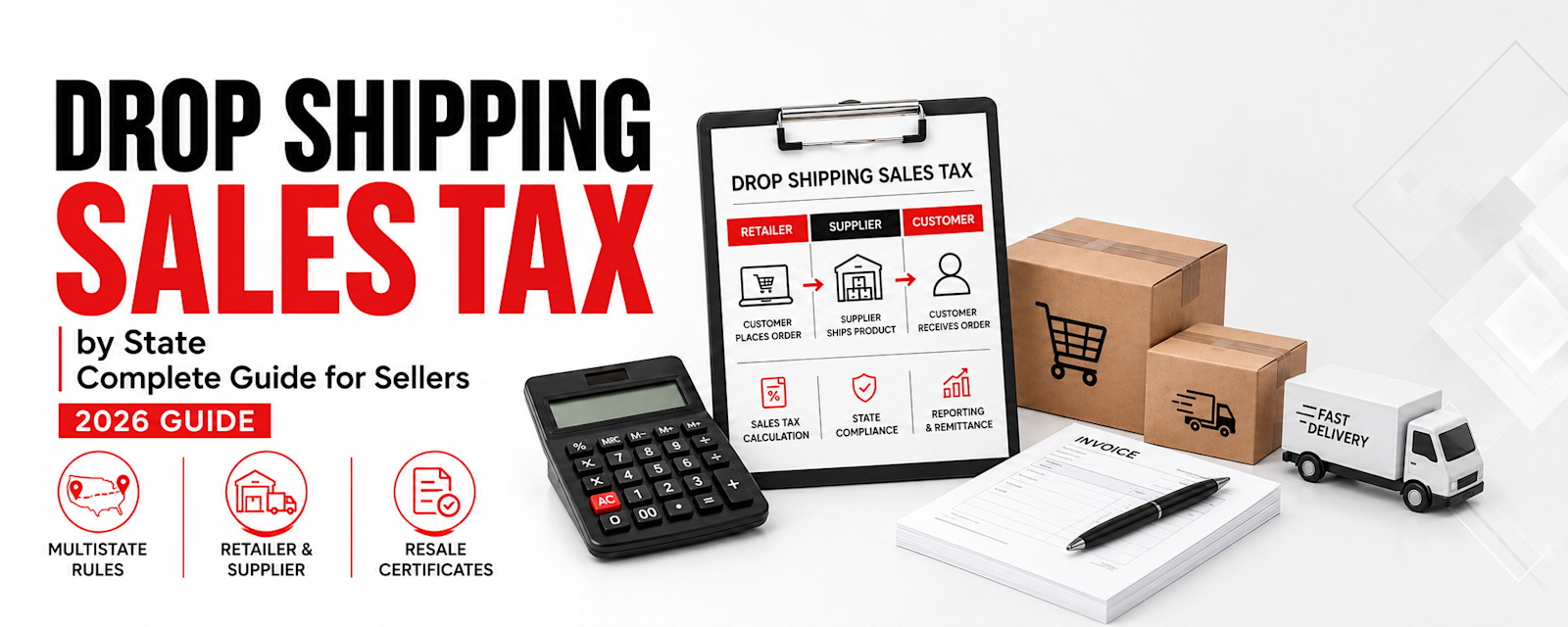
A customer places an order on your website. You forward the order to a supplier. The supplier ships the product directly to your customer.
You never physically touch the merchandise.
But from a sales tax perspective, that simple fulfillment model can create one of the most complicated transaction structures in ecommerce.
Why?
Because a typical drop shipment involves:
Three parties.
Two separate sales.
Potential tax obligations in multiple states.
And potentially two different resale-certificate questions.
The retailer may be required to collect sales tax from the customer, while the supplier may simultaneously require the retailer to prove that the supplier's wholesale transaction qualifies as a sale for resale.
If the retailer provides the wrong documentation—or is not registered in a state that requires local registration—the supplier may be required to charge sales tax on the wholesale invoice even though the retailer is reselling the merchandise.
This 2026 guide explains how drop shipping sales tax works, who is responsible for collecting tax, when resale certificates are required, how economic nexus affects drop shippers, and which states deserve additional attention.
Important: Sales and use tax rules vary by state and can change. Drop shipment transactions are particularly fact-sensitive. This guide provides general information and does not constitute legal or tax advice.
What Is Drop Shipping?
Drop shipping is a fulfillment model in which a retailer sells merchandise it does not physically maintain or ship itself.
A typical transaction involves:
Party 1 — Customer
The end customer purchases the product.
Party 2 — Retailer
The retailer markets the product, accepts the customer's order and payment, and purchases the merchandise from a supplier.
Party 3 — Supplier / Drop Shipper
The supplier sells the merchandise to the retailer but ships it directly to the retailer's customer.
The transaction therefore looks like this:
Customer → buys from → Retailer
Retailer → buys from → Supplier
Supplier → ships directly to → Customer
From a logistics perspective, there is only one shipment.
From a sales tax perspective, however, there are generally two sales transactions.
New York, for example, explicitly describes a drop shipment as involving the sale from the third-party supplier to the primary seller and a second sale from the primary seller to the end customer.
The Two Sales Tax Questions in Every Drop Shipment
A drop shipping business should analyze two separate transactions.
Transaction 1 — Retailer → Customer
The first question is:
Does the retailer need to collect sales tax from the customer?
That depends primarily on:
Where the customer receives the product
Whether the product is taxable
Whether the retailer has physical nexus
Whether the retailer has economic nexus
Whether a marketplace facilitator is collecting the tax
Whether the customer qualifies for an exemption
Transaction 2 — Supplier → Retailer
The second question is:
Can the supplier sell the merchandise to the retailer tax-free as a sale for resale?
That generally depends on whether the retailer provides acceptable resale documentation.
This is where drop shipping becomes substantially more complicated.
Example of a Simple Drop Shipment
Suppose an online retailer sells a desk for: Customer price $1,000
The retailer purchases the desk from its supplier for: Wholesale cost $650
The supplier ships the desk directly to the retailer's customer.
Potential tax treatment:
Retailer → Customer
If the retailer has nexus in the customer's state and the desk is taxable, the retailer generally charges the customer applicable sales tax on the $1,000 retail selling price.
Supplier → Retailer
The retailer is buying the $650 desk for resale.
Ideally, the retailer gives the supplier a valid resale certificate so that the supplier does not charge sales tax on the $650 wholesale transaction.
This produces the intended chain:
Supplier → Retailer = Sale for Resale
Retailer → Customer = Taxable Retail Sale
What Happens If the Resale Certificate Is Not Accepted?
This is one of the biggest financial problems in drop shipping.
Suppose:
Wholesale cost: $650 Supplier charges tax: 8% Supplier tax: $52
The retailer sells the product for:
Retail price: $1,000 Customer sales tax: 8% Customer tax: $80
The retailer could now have:
$52 of tax embedded in its cost plus $80 collected from the customer
The $52 charged by the supplier is not automatically a credit against the $80 collected from the customer.
The retailer may need to determine whether:
The supplier tax was legally due
A resale certificate can be provided later
The supplier can issue a refund
A state refund claim is possible
Additional documentation is required
This is why resale-certificate management is a major component of drop shipping profitability.
Economic Nexus Still Applies to Drop Shipping
Drop shipping does not eliminate economic nexus.
A retailer can have no:
Office
Warehouse
Employee
Storefront
in a state and still be required to register and collect sales tax after exceeding that state's economic nexus threshold.
The supplier performing fulfillment does not replace the retailer for purposes of the retailer's own customer sale.
Therefore, every drop shipping business should track its sales by destination state.
For a complete state-by-state analysis, see our Economic Nexus Thresholds by State: 2026 Sales Tax Guide for Online Sellers.
Does Using a Drop Shipper Automatically Create Physical Nexus?
Not necessarily.
The presence of an unrelated supplier in another state does not, by itself, answer whether the retailer has nexus there.
Businesses should separately analyze factors such as:
Inventory ownership
Warehousing arrangements
Fulfillment agreements
Employees
Contractors
Agents
Installation services
Repair services
Representatives
Physical property
Economic nexus thresholds
The legal relationship between the retailer and supplier can matter.
Never assume:
“My supplier is in California, therefore I automatically have California nexus.”
or:
“I don't own inventory, therefore I cannot have nexus.”
Both conclusions can be incorrect depending on the facts.
Resale Certificates Are Critical in Drop Shipping
The retailer's purchase from the supplier is ordinarily intended for resale.
That means it may qualify for a resale exemption.
But the supplier must generally document why it did not collect sales tax.
This is where the challenge begins.
A retailer might be registered in: Florida
but its supplier ships to customers in: California, Texas, New York, Illinois, Georgia, and Washington.
Can the retailer simply give every supplier its Florida resale certificate? Not necessarily.
Some states allow a retailer to use an identification number or certificate issued by another state.
Other states require:
State-specific certificates
Local registration
Specific statements
Customer exemption documentation
Special drop-shipment treatment
The Multistate Tax Commission's Uniform Sales & Use Tax Resale Certificate can be used in many states, but MTC itself warns that state acceptance requirements vary and can change.
Streamlined Sales Tax Makes Drop Shipping Easier in 24 States
The Streamlined Sales Tax system provides one of the most useful multistate tools for drop shippers.
The current Streamlined framework states that when a drop shipper receives a properly completed exemption certificate from the retailer purchasing the goods for resale, the drop shipper is generally relieved from sales tax liability on products delivered to the retailer's customer in a Streamlined member state.
Importantly, when the retailer is not registered in the destination state, the identification number on the Streamlined certificate may be a sales tax ID issued by another state, subject to state requirements. Georgia requires seller verification of the purchaser's ID.
The 24 Streamlined member states are:
Arkansas
Georgia
Indiana
Iowa
Kansas
Kentucky
Michigan
Minnesota
Nebraska
Nevada
New Jersey
North Carolina
North Dakota
Ohio
Oklahoma
Rhode Island
South Dakota
Tennessee
Utah
Vermont
Washington
West Virginia
Wisconsin
Wyoming
For retailers drop shipping into these states, the Streamlined Sales Tax Exemption Certificate can significantly simplify documentation.
However, businesses should still confirm the applicable identification-number and exemption requirements.
States Without a General Statewide Sales Tax
Five states do not impose a conventional statewide general sales tax:
Delaware
Delaware does not impose state or local retail sales tax, although it imposes gross receipts taxes on many sellers.
Montana
Montana does not impose a general-use sales tax.
New Hampshire
New Hampshire does not impose a general sales or use tax.
Oregon
Oregon does not impose a general sales or use transaction tax.
Alaska
Alaska has no statewide sales tax, but local governments can impose sales taxes.
Remote sellers can also have collection obligations through the Alaska Remote Seller Sales Tax Commission for participating local jurisdictions. The statewide remote-sales threshold is currently $100,000, and Alaska removed its former 200-transaction threshold effective January 1, 2025.
Therefore, “Alaska has no state sales tax” should not be interpreted as “drop shipping into Alaska can never create a sales tax obligation.”
States Requiring Special Attention for Drop Shipments
The remaining non-Streamlined states should be analyzed individually.
Alabama
Alabama provides relatively favorable drop-shipment guidance.
The Alabama Department of Revenue states that a supplier/drop shipper should accept a reseller's home-state resale certificate when merchandise is purchased for resale and shipped to an Alabama customer.
If the remote retailer's sale to the Alabama customer is taxable, the retailer remains responsible for collection when applicable.
Arizona
Arizona uses its Transaction Privilege Tax system rather than a conventional seller-collected sales tax structure.
Drop shippers should confirm:
TPT nexus
Destination treatment
Resale documentation
Local jurisdiction considerations
and use Arizona-specific exemption documentation where required.
California — Major Drop Shipment Rule
California deserves special attention.
California can treat the California drop shipper as the retailer responsible for tax when:
The supplier/drop shipper makes delivery to a California consumer;
The actual retailer is located outside California; and
The true retailer does not hold a California seller's permit or Certificate of Registration–Use Tax.
If the true retailer holds the appropriate California registration, it can issue a resale certificate to the drop shipper.
If it does not, the drop shipper may become responsible for reporting and paying California tax.
California also has an unusual tax-base rule.
The amount subject to tax can generally be:
The actual retail price charged to the California customer; or
The drop shipper's price to the retailer plus a
10% markup
when the actual retail selling price is not known.
A lower documented markup may be permitted when it accurately represents the retailer's selling price.
Example
Supplier sells to retailer: $200
Retailer's customer price is unknown.
Potential California tax measure: $200 + 10% = $220
That is very different from simply applying tax to the supplier's $200 invoice.
Colorado
Colorado requires careful analysis because state sales tax and local home-rule jurisdictions can create additional complexity.
Businesses should verify:
State registration
Local registration where applicable
Destination sourcing
Exemption certificate acceptance
Colorado Retail Delivery Fee requirements
for qualifying transactions.
Connecticut
Connecticut maintains specific drop-shipment rules.
Its published guidance explains that a resale or exemption certificate issued by an unregistered retailer does not necessarily exempt the wholesaler's drop-shipped sale.
Depending on the transaction, acceptable documentation can instead involve Connecticut-specific documentation, an MTC certificate, or documentation from the Connecticut customer.
This is a good example of why a home-state resale certificate cannot simply be applied universally.
Florida
Florida also deserves additional attention.
Florida issues its own Annual Resale Certificate for Sales Tax to registered dealers and requires exempt resale transactions to be properly documented.
Florida's current guidance also directs sellers dealing with nonresident dealers to separate rules for documenting those sales.
Florida has specifically advised in a drop-shipment fact pattern that a registered Florida drop shipper could not simply accept another state's resale certificate as a substitute for Florida documentation.
Because the outcome can depend heavily on how the goods enter Florida, who performs delivery, and the status of the retailer, Florida drop shipments should be reviewed carefully rather than assuming a home-state certificate will work.
Hawaii
Hawaii uses the General Excise Tax (GET) rather than a traditional sales tax.
Wholesale and resale transactions can receive different GET rates or treatment, but Hawaii has its own registration and documentation requirements.
Businesses should not apply ordinary mainland sales-tax assumptions to Hawaii drop shipments.
Idaho
Idaho is not a Streamlined Sales Tax member.
Drop shipping sellers should verify Idaho's resale-documentation rules and whether the applicable certificate permits use of an out-of-state registration number.
Illinois — Important 2026 Change
Illinois made a significant remote-seller change effective January 1, 2026.
The old 200-transaction economic nexus threshold was eliminated.
Remote retailers and marketplace facilitators are now subject to Illinois' economic nexus standard based on:
$100,000 or more in cumulative gross receipts from Illinois sales of tangible personal property during the applicable lookback period.
The transaction-count test no longer applies.
Drop shipping sellers therefore need to ensure their Illinois nexus calculations reflect the 2026 rules.
Louisiana — Important 2026 Documentation Change
Louisiana uses particularly strict exemption documentation.
The Louisiana Department of Revenue states that Louisiana does not accept other-state exemptions or the multistate exemption certificate for these purposes.
A drop-shipment letter may be required to document qualifying third-party transactions in bona fide interstate commerce.
Louisiana also made an important 2026 change:
Louisiana resale certificates are now valid for one year and must be renewed annually.
Any company maintaining a resale-certificate library should update its expiration tracking accordingly.
Maine
The Multistate Tax Commission specifically advises businesses to contact Maine Revenue Services regarding use of its multijurisdiction resale certificate.
Therefore, retailers should verify Maine's requirements directly before relying on generic multistate documentation.
Maryland
Maryland has strict third-party drop-shipment rules.
Maryland's tax guidance describes a transaction where an unregistered retailer instructs a supplier to deliver merchandise directly to a Maryland customer.
The supplier must generally either:
Require the retailer to obtain a Maryland sales and use tax license and provide a valid resale certificate; or
Charge tax on the supplier's sale to the retailer.
Maryland specifically warns that the retailer needs Maryland resale documentation even when the end customer's transaction could otherwise qualify for resale or another exemption.
Massachusetts
Massachusetts also applies special drop-shipment rules.
Current Massachusetts guidance states that a business with Massachusetts nexus may be required to collect tax when it ships goods to a Massachusetts consumer on behalf of a retailer that is not required to collect because it lacks Massachusetts nexus.
Massachusetts generally does not allow that supplier simply to accept a Massachusetts resale certificate from a customer with no Massachusetts nexus, although prescribed alternative documentation may be available depending on the facts.
This makes Massachusetts another state where drop shippers should avoid assuming their home-state resale permit will automatically protect the supplier.
Mississippi
Mississippi's official drop-shipment guidance provides a useful framework.
A supplier with Mississippi nexus that delivers products into Mississippi generally must charge tax unless the retailer provides acceptable exemption documentation.
Mississippi also recognizes a flow-through concept in certain transactions where the retailer lacks a Mississippi resale certificate but the Mississippi end customer has a valid exemption.
The customer's exemption documentation may, under qualifying circumstances, flow through the retailer to the supplier.
Missouri
Missouri has its own resale and exemption documentation requirements.
Retailers using multistate certificates should confirm that the form, registration number, and transaction type satisfy Missouri's current rules.
New Mexico
New Mexico uses the Gross Receipts Tax (GRT) system rather than a conventional sales tax.
Resale-type transactions frequently involve New Mexico's nontaxable transaction certificate framework.
Dropshipping businesses selling into New Mexico should therefore avoid treating it exactly like a conventional sales-tax state.
New York
New York provides specific drop-shipment guidance.
New York treats drop shipping as two separate sales and allows certain qualified out-of-state purchasers to use Form ST-120, Resale Certificate, for tangible personal property purchased for resale even when the purchaser is located outside New York, subject to the state's conditions.
This makes New York more workable than some of the strict-registration states, but the certificate must still be properly completed and applicable to the transaction.
Pennsylvania
Pennsylvania drop-shipment transactions should be documented using acceptable Pennsylvania sales-tax exemption documentation.
Retailers should confirm certificate requirements with the Pennsylvania Department of Revenue before using an out-of-state certificate for recurring drop shipments.
South Carolina
South Carolina should also be treated as a state requiring individual review of:
Nexus
Resale documentation
Destination sourcing
Supplier collection obligations
rather than assuming another state's certificate will automatically be accepted.
Texas
Texas permits resale certificates to include an out-of-state sales tax registration or permit number under qualifying circumstances.
Texas guidance requires resale certificates to contain specific purchaser information and documentation of what is being purchased for resale.
That makes Texas significantly more manageable for many multistate drop shipping sellers than states requiring local registration.
Virginia
Virginia maintains its own sales tax exemption and resale certificate rules.
Retailers drop shipping into Virginia should verify that their supplier has the correct resale documentation and should separately determine whether the retailer itself has Virginia nexus and a collection obligation.
Washington, D.C.
The District of Columbia imposes its own sales tax and exemption-certificate requirements.
Because D.C. is not a state and is not part of the Streamlined Sales Tax system, it should be maintained as its own jurisdiction in any multistate compliance matrix.
Drop Shipping and Marketplace Facilitator Laws
Drop shipping and marketplace selling frequently overlap, but they are not the same issue.
Suppose a retailer sells through:
Amazon
Etsy
eBay
Walmart
Many states require the marketplace facilitator to collect and remit sales tax on facilitated transactions. However, that does not necessarily eliminate the supplier-side problem.
The transaction may still look like: Supplier → Marketplace Seller → Marketplace Customer
The marketplace may collect tax from the customer, but the seller still needs to prove to its supplier that the supplier's sale is for resale.
Marketplace sellers can also have separate sales tax obligations for:
Shopify sales
WooCommerce sales
Direct website sales
Wholesale orders
Phone orders
B2B transactions
Streamlined Sales Tax specifically notes that marketplace sellers may still have registration and filing obligations depending on the state and their direct sales.
We cover this issue in detail in our Marketplace Facilitator Sales Tax: Amazon, Etsy, eBay & Walmart Explained guide.
Drop Shipping and Shipping Charges
Drop shipping does not change the normal state rules for shipping taxability.
Suppose:
Product: $100 Shipping: $15
Whether tax applies to $100 or $115 depends on the destination state's treatment of shipping charges.
Relevant factors can include:
Product taxability
Separately stated shipping
Mandatory vs. optional delivery
Shipping vs. handling
Who performs the delivery
Mixed taxable and exempt products
For the complete state-by-state analysis, see our Are Shipping Charges Taxable? Sales Tax on Shipping by State: 2026 Guide.
Drop Shipping and Use Tax
If the retailer does not collect sales tax and no other responsible party collects it, that does not necessarily mean the transaction becomes tax-free.
The end customer may owe use tax.
Similarly, if a retailer purchases inventory tax-free for resale but later uses the merchandise internally, use tax can become due.
See our Sales Tax vs. Use Tax: What Businesses Need to Know in 2026 for a complete explanation.
B2B Drop Shipping Creates Another Layer of Complexity
Not every drop shipment ends with a consumer.
Suppose:
Manufacturer → Distributor → Retailer but the manufacturer ships directly to the retailer.
The distributor's customer is also buying for resale.
Now potentially both transactions may be resale transactions.
The documentation chain becomes critical.
The parties should determine:
Who is purchasing for resale?
Which resale certificate applies?
Which party keeps the certificate?
Which state controls the documentation?
Is the end customer registered?
Can the end customer's certificate flow through?
Does the supplier have nexus?
States such as Mississippi specifically recognize flow-through concepts in certain qualifying transactions.
The Cost of Getting Drop Shipping Sales Tax Wrong
Incorrect sales tax setup can affect the economics of every order.
Imagine:
Supplier cost: $70 Retail price: $100 Gross margin before tax issue: $30
If the supplier unexpectedly charges 8% tax:
Supplier tax: $5.60
New effective cost: $75.60
Gross margin: $24.40
Your margin just declined by: 18.7% without changing your selling price.
At scale, resale-certificate problems can materially affect profitability.
Recommended Drop Shipping Compliance Workflow
Step 1 — Map Your Suppliers
Create a list showing:
Supplier legal name
Supplier location
States where supplier has nexus
Products supplied
Shipping origin
Resale documentation on file
Step 2 — Map Your Customer Sales by State
Track:
Gross sales
Taxable sales
Transaction count where still relevant
Marketplace sales
Direct sales
B2B sales
Step 3 — Monitor Economic Nexus
Compare your activity with each state's applicable economic nexus threshold.
Do not rely on outdated thresholds.
Illinois, for example, eliminated its 200-transaction threshold effective January 1, 2026.
Step 4 — Register Where Required
Once a registration obligation exists, register before collecting tax when required.
Do not begin collecting a tax simply because your ecommerce platform allows you to switch it on.
Step 5 — Build a Resale Certificate Matrix
For each state, identify:
Certificate required
Home-state certificate accepted?
SST certificate accepted?
MTC certificate accepted?
Destination-state registration required?
Expiration date
Renewal requirement
Verification requirement
Step 6 — Send Certificates to Suppliers
Don't wait until suppliers begin charging tax.
Provide documentation proactively.
Step 7 — Verify Supplier Exemption Status
Confirm the supplier has actually applied the certificate to your account.
A certificate emailed to the wrong department does not protect your margin.
Step 8 — Review Supplier Invoices
Look for: Sales Tax: $0
when the transaction should be a documented purchase for resale.
Unexpected supplier tax should be investigated immediately.
Step 9 — Review Customer Tax Collection
Separately verify:
Correct destination
Correct product taxability
Correct rate
Shipping taxability
Marketplace treatment
Customer exemptions
Step 10 — Retain Documentation
Keep:
Resale certificates
Exemption certificates
Supplier invoices
Customer invoices
Marketplace reports
Shipping records
Nexus calculations
Registration confirmations
Certificate verification records
for the retention period required by each jurisdiction.
Common Drop Shipping Sales Tax Mistakes
Mistake #1 — “I Never Touch the Product, So I Don't Have Sales Tax Obligations”
Incorrect.
Fulfillment method does not eliminate sales tax nexus.
Mistake #2 — Using One Resale Certificate Everywhere
Some states accept home-state or multistate documentation.
Others do not.
Mistake #3 — Ignoring Supplier Sales Tax
A retailer can collect customer tax correctly while still unnecessarily paying tax to suppliers.
Mistake #4 — Assuming Amazon Solves Everything
Marketplace facilitator collection may solve the customer-side tax on marketplace transactions.
It does not automatically resolve supplier resale documentation or direct website sales.
Mistake #5 — Tracking Only Direct Sales for Nexus
Some states include marketplace sales in their threshold calculations.
The rules vary by state.
Mistake #6 — Registering Everywhere Without Analysis
Registration creates filing obligations.
A company should not register in dozens of states merely because a supplier requests certificates without first understanding the compliance consequences.
Mistake #7 — Ignoring Certificate Expiration
Some certificates require renewal.
Louisiana, for example, now requires annual resale-certificate renewal.
Mistake #8 — Forgetting Shipping Taxability
Shipping and handling treatment varies by state.
Mistake #9 — Assuming Supplier Tax Can Always Be Credited
Tax charged to the retailer by a supplier is not automatically interchangeable with tax the retailer owes on its sale to the customer.
Drop Shipping Sales Tax Checklist
Before launching or expanding a drop shipping operation:
Identify every state where you sell
Identify every supplier and shipping origin
Track economic nexus by state
Identify physical nexus
Separate marketplace and direct sales
Register where required
Determine product taxability
Determine shipping taxability
Identify resale certificate requirements
Confirm whether home-state certificates are accepted
Review SST certificate options
Review MTC certificate options
Identify strict drop-shipment states
Provide certificates to suppliers
Confirm suppliers applied exemptions
Review supplier invoices for unexpected tax
Verify customer tax collection
Track certificate expirations
Maintain audit documentation
Review rules annually
Final Takeaway
Drop shipping eliminates the need to physically warehouse merchandise. It does not eliminate sales tax compliance. Every drop shipping seller should understand three separate questions:
1. Does my business have nexus in the customer's state?
That determines whether the retailer may need to register and collect tax.
2. Is my sale to the customer taxable?
That depends on the product, customer, destination, and state rules.
3. Can my supplier sell the product to me tax-free for resale?
That depends heavily on resale-certificate documentation. A successful multistate drop shipping compliance system therefore needs to coordinate:
Economic Nexus + Sales Tax Registration + Product Taxability + Resale Certificates + Supplier Tax + Shipping Tax + Marketplace Facilitator Rules + Use Tax
Ignoring any one of these can create overcollection, undercollection, supplier tax leakage, or audit exposure.
Need Help With Drop Shipping Sales Tax Compliance?
Managing drop shipping sales tax across multiple states can quickly become difficult as sales grow and additional suppliers, marketplaces, and states are added.
Capital Edge Firm helps businesses evaluate:
Economic nexus
Sales tax registration
Multistate sales tax compliance
Resale certificate documentation
Sales and use tax
Supplier tax issues
Ecommerce sales tax
Sales tax filings
Transaction review
Account reconciliation
If your ecommerce or drop shipping business sells into multiple states and you are unsure where you should register, collect tax, or provide resale certificates, contact Capital Edge Firm to discuss your sales tax compliance needs.