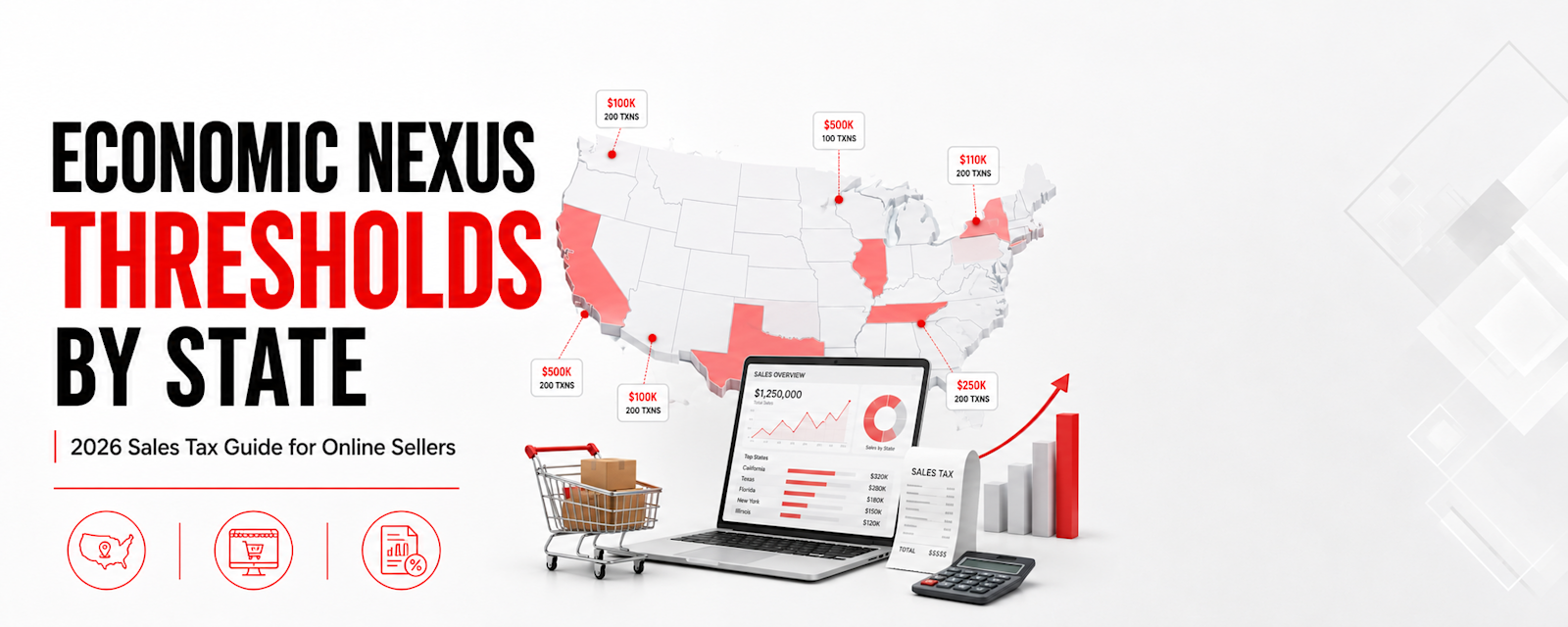
Selling products online makes it possible for a business in Florida, Texas, California, or virtually anywhere else to reach customers across the United States within minutes.
Sales tax compliance does not expand quite as simply.
A business can develop a legal obligation to register, collect, report, and remit sales tax in a state even when it has no office, storefront, employee, or traditional physical location there.
That obligation is commonly known as economic nexus.
Since the U.S. Supreme Court's 2018 decision in South Dakota v. Wayfair, Inc., states have been permitted to impose sales tax collection requirements based on a seller's economic activity in the state rather than physical presence alone.
The difficult part is that there is no single nationwide threshold.
A seller might need:
More than $100,000 of sales in one state.
$250,000 in another.
More than $500,000 somewhere else.
A particular number of transactions.
A combination of both sales and transaction thresholds.
A calculation based on gross sales.
A calculation based on retail sales.
A calculation based only on taxable sales.
A current-year test.
A prior-year test.
A rolling 12-month calculation.
And crossing a threshold is not the only way to establish nexus.
Employees, inventory, warehouses, contractors, fulfillment centers, trade-show activity, and other physical or representational connections can potentially create sales tax nexus even when sales remain below the economic threshold.
For businesses selling nationwide, economic nexus should therefore be treated as an ongoing compliance calculation, not a question that is reviewed only once a year.
What Is Economic Nexus?
Economic nexus is a sufficient level of economic activity within a state that allows the state to require an out-of-state seller to comply with its sales and use tax laws.
A typical economic nexus rule looks something like this:
A remote seller must register and begin collecting sales tax when its sales into the state exceed a specified dollar amount during a defined measurement period.
Some jurisdictions also use transaction-count tests.
For example, a state may establish nexus when a remote seller has either:
$100,000 in qualifying sales,
or
200 separate transactions.
Other states may require both conditions to be satisfied.
The difference between OR and AND is extremely important.
New York, for example, generally requires an out-of-state business with no physical presence to exceed $500,000 in gross receipts and make more than 100 sales of tangible personal property delivered into New York during the immediately preceding four sales tax quarters. Both conditions must be met for that particular economic nexus test.
Economic Nexus vs. Physical Nexus
Economic nexus did not replace physical nexus.
It added another way for states to establish a sales tax connection.
A company may have economic nexus because its sales exceed a state's threshold.
A company may instead have physical nexus because it has activities or property inside the state.
Potential physical nexus triggers can include:
An office
A retail location
A warehouse
Inventory
Employees
Remote employees
Sales representatives
Independent contractors performing certain activities
Installation or repair personnel
Company-owned property
Fulfillment inventory
Certain trade-show activities
Regular deliveries using company vehicles
That distinction matters because the small-seller economic threshold generally does not protect a business that already has nexus through physical presence.
Streamlined Sales Tax specifically notes that a business with physical presence in a state is not treated as merely a remote seller for purposes of the economic threshold and may be required to register regardless of sales volume.
Why Economic Nexus Matters to Online Sellers
Consider an online store headquartered in Florida.
The company has:
No stores outside Florida.
No employees outside Florida.
A website that ships nationwide.
Sales through its own website.
Additional sales through Amazon.
Wholesale customers that provide resale certificates.
Historically, a business might have assumed that it only needed to collect Florida sales tax because that was where it operated.
That assumption is no longer safe.
Its California revenue could create California economic nexus.
Its Texas revenue could create Texas economic nexus.
Its transaction volume could create nexus in a state that still uses a transaction test.
Its marketplace sales might count toward a state's economic nexus calculation even though Amazon itself collects and remits the tax on those marketplace transactions.
Meanwhile, sales made to wholesalers might count toward the economic nexus threshold in one state but be excluded from the calculation in another.
This is why businesses selling nationally need state-by-state sales data, not merely a company-wide annual sales total.
2026 Economic Nexus Thresholds by State
The following directory summarizes the principal sales tax economic nexus thresholds generally applicable to remote sellers as of August 2026.
Important: The threshold shown below is a reference point, not a complete substitute for the state's statute or administrative guidance. States differ regarding which sales count, whether marketplace sales are included, when the threshold is tested, when collection must begin, and whether other activities independently create nexus.
Jurisdiction | Economic Nexus Threshold | Transaction Test | Measurement Period | Important Note |
|---|---|---|---|---|
Alabama | $250,000 | None | Previous calendar year. | Based generally on qualifying direct retail sales into Alabama. Marketplace and resale exclusions may affect the calculation. |
Alaska | $100,000 | None | Current or previous calendar year. | Alaska has no statewide sales tax, but participating local jurisdictions use the ARSSTC remote seller system. Transaction threshold repealed January 1, 2025. |
Arizona | $100,000 | None | Current or previous calendar year. | Arizona administers Transaction Privilege Tax rather than a conventional seller-imposed sales tax structure. |
Arkansas | $100,000 | OR 200 transactions | Current or previous calendar year. | Either test may trigger the remote seller requirement. |
California | $500,000 | None | Current or previous calendar year. | Threshold generally applies to total sales of tangible personal property delivered into California. |
Colorado | $100,000 | None | Current or previous calendar year. | Colorado also has significant local sales tax considerations, including home-rule jurisdictions. |
Connecticut | $100,000 | AND 200 transactions | 12-month period ending September 30. | Both components apply under the economic nexus test. |
Delaware | No statewide sales tax. | N\A | N\A | Delaware does not impose a general state sales tax, although other business taxes may apply. |
District of Columbia | $100,000 | OR 200 transactions | Current or previous calendar year. | Either the sales or transaction test may establish economic nexus. |
Florida | $100,000 | None | Previous calendar year. | Applies to taxable remote sales of tangible personal property into Florida. |
Georgia | $100,000 | OR 200 transactions | Current or previous calendar year. | Either threshold can trigger economic nexus. |
Hawaii | $100,000 | OR 200 transactions | Current or previous calendar year. | Hawaii imposes General Excise Tax rather than a conventional sales tax system. |
Idaho | $100,000 | None | Current or previous calendar year. | Remote sellers should monitor Idaho sales throughout the year. |
Illinois | $100,000 | None | Preceding 12-month period. | Illinois eliminated its 200-transaction economic nexus test effective January 1, 2026. |
Indiana | $100,000 | None | Current or previous calendar year. | Indiana eliminated its transaction-count test. |
Iowa | $100,000 | None | Current or previous calendar year. | Sales threshold applies without a separate transaction test. |
Kansas | $100,000 | None | Current or previous calendar year. | Sales threshold only. |
Kentucky | $100,000 | OR 200 transactions | Current or previous calendar year. | Either test may create economic nexus. |
Louisiana | $100,000 | None | Current or previous calendar year. | Louisiana removed its former transaction threshold. |
Maine | $100,000 | None | Current or previous calendar year. | Maine previously had a transaction test but now uses the sales threshold. |
Maryland | $100,000 | OR 200 transactions | Current or previous calendar year. | Either threshold may apply. |
Massachusetts | $100,000 | None | Current or previous calendar year. | Sales threshold only under the general remote seller economic nexus rule. |
Michigan | $100,000 | OR 200 transactions | Previous calendar year. | Either sales or transaction volume can trigger the requirement. |
Minnesota | $100,000 | OR 200 transactions | Rolling 12-month period. | Sellers should monitor the rolling measurement period rather than relying only on calendar-year totals. |
Mississippi | $250,000 | None | Prior 12-month period. | One of the higher dollar thresholds among states imposing sales tax. |
Missouri | $100,000 | None | Previous 12-month period. | Missouri uses a sales threshold without a separate transaction test. |
Montana | No statewide sales tax. | N\A | N\A | Montana does not impose a general statewide sales tax. |
Nebraska | $100,000 | OR 200 transactions | Current or previous calendar year. | Either threshold may apply. |
Nevada | $100,000 | OR 200 transactions | Current or previous calendar year. | Either threshold may establish economic nexus. |
New Hampshire | No statewide sales tax. | N\A | N\A | New Hampshire does not impose a general statewide sales tax. |
New Jersey | $100,000 | OR 200 transactions | Current or previous calendar year. | Sellers should monitor both revenue and transaction count. |
New Mexico | $100,000 | None | Previous calendar year. | New Mexico uses gross receipts tax terminology and rules that differ from traditional sales tax systems. |
New York | $500,000 | AND more than 100 sales | Previous four sales tax quarters. | Both the revenue and transaction requirements generally must be met under the remote-seller economic nexus test. |
North Carolina | $100,000 | None | Current or previous calendar year. | Transaction threshold was repealed effective July 1, 2024. |
North Dakota | $100,000 | None | Current or previous calendar year. | Transaction threshold was previously eliminated. |
Ohio | $100,000 | OR 200 transactions | Current or previous calendar year. | Either test can establish economic nexus. |
Oklahoma | $100,000 | None | Current or previous calendar year. | Current rule uses the sales threshold rather than a transaction test. |
Oregon | No statewide sales tax | N/A | N/A | Oregon does not impose a general statewide sales tax. |
Pennsylvania | $100,000 | None | Previous 12 months. | Pennsylvania uses a rolling lookback rather than simply a calendar-year test. |
Rhode Island | $100,000 | OR 200 transactions | Previous calendar year. | Either sales volume or transaction volume may trigger nexus. |
South Carolina | $100,000 | None | Current or previous calendar year. | General remote seller threshold is sales-based. |
South Dakota | $100,000 | None | Current or previous calendar year. | South Dakota eliminated its transaction-count threshold after originally using one in the law involved in Wayfair. |
Tennessee | $100,000 | None | Previous 12-month period. | Sales threshold only. |
Texas | $500,000 | None | Previous 12 calendar months. | Texas calls this a remote seller safe harbor. Marketplace sales are included in determining the threshold. |
Utah | $100,000 | None | Current or previous calendar year. | Utah eliminated its 200-transaction threshold effective July 1, 2025. |
Vermont | $100,000 | OR 200 transactions | 12-month period. | Either test may establish economic nexus. |
Virginia | $100,000 | OR 200 transactions | Current or previous calendar year. | Either test may apply. |
Washington | $100,000 | None | Current or previous calendar year. | Washington previously had a transaction threshold but now uses the sales test. |
West Virginia | $100,000 | OR 200 transactions | Current or previous calendar year. | Either threshold may apply. |
Wisconsin | $100,000 | None | Current or previous calendar year. | Wisconsin eliminated its transaction test. |
Wyoming | $100,000 | None | Current or previous calendar year. | Wyoming eliminated its 200-transaction threshold. |
The table reflects 2026 remote-seller guidance compiled from current multistate guidance and state sources. The dominant dollar threshold remains $100,000, while Alabama and Mississippi generally use $250,000 and California, New York, and Texas use $500,000 thresholds. Several jurisdictions still retain transaction-count tests.
Important 2025–2026 Economic Nexus Changes
Economic nexus laws are still evolving.
A business that built its compliance spreadsheet several years ago should not assume that the rules remain unchanged.
Illinois Eliminated the 200-Transaction Threshold
Beginning January 1, 2026, Illinois no longer uses the 200-transaction test for remote retailers.
The economic nexus test is now based on whether cumulative gross receipts from qualifying sales to Illinois purchasers reach $100,000 during the applicable preceding 12-month period.
This is particularly important for businesses making large numbers of low-dollar transactions.
A seller with:
$40,000 in Illinois sales
450 transactions
could previously have triggered the transaction threshold.
In 2026, the transaction count alone no longer establishes economic nexus under that rule.
Utah Eliminated Its Transaction Threshold
Utah removed its 200-transaction threshold effective July 1, 2025.
A remote seller now generally has economic presence when sales of qualifying property, electronically transferred products, or services into Utah generate more than $100,000 of gross revenue during the current or previous calendar year.
Alaska Eliminated Its 200-Transaction Threshold
Alaska does not impose a statewide sales tax.
However, many municipalities levy local sales tax, and participating jurisdictions use the Alaska Remote Seller Sales Tax Commission system for remote sales.
Effective January 1, 2025, ARSSTC eliminated the former 200-transaction threshold. The current statewide economic threshold for the participating local system is $100,000 in gross remote sales during the current or previous calendar year.
North Carolina Eliminated Its Transaction Threshold
Effective July 1, 2024, North Carolina repealed its transaction-based economic nexus test.
The current remote seller threshold is based on gross sales exceeding $100,000 from remote sales sourced to North Carolina during the previous or current calendar year. North Carolina specifically states that sales as a marketplace seller are included in that calculation.
$100,000 Does Not Mean the Same Thing in Every State
One of the biggest mistakes in multistate sales tax compliance is creating a spreadsheet that simply asks:
Did we sell $100,000 into this state?
That number may not mean the same thing from one jurisdiction to another.
States can define their threshold using:
Gross Sales
A gross-sales threshold can include sales that ultimately are not subject to sales tax.
Depending on the state's rules, this may include:
Taxable sales
Exempt sales
Sales to exempt organizations
Sales for resale
Marketplace sales
Nontaxable transactions
Retail Sales
Retail sales generally exclude transactions made for resale but may still include other exempt retail transactions.
Taxable Sales
A taxable-sales threshold may count only transactions that are actually subject to the applicable sales or use tax.
Streamlined Sales Tax specifically distinguishes among gross sales, retail sales, and taxable sales when calculating economic nexus thresholds.
That distinction can dramatically change the result.
Do Resale Transactions Count Toward Economic Nexus?
Sometimes.
This is where economic nexus connects directly with resale certificate compliance.
Assume a company has $180,000 in sales into a state:
$120,000 wholesale sales for resale
$60,000 taxable retail sales
If the state measures gross sales, the business may have $180,000 toward the threshold.
If it measures retail sales, properly documented sales for resale may be excluded.
If it measures taxable sales, only taxable transactions may count.
The seller therefore needs both:
Accurate state-level sales reporting.
Properly documented resale and exemption certificates.
If your business regularly accepts resale certificates, see our State-by-State Resale Certificate Verification Directory for guidance on verifying customer documentation.
Do Amazon, Etsy, eBay, and Walmart Sales Count Toward Economic Nexus?
Possibly—and this is one of the most misunderstood areas of ecommerce sales tax.
Marketplace facilitator laws generally require qualifying marketplaces such as Amazon, Etsy, eBay, or Walmart Marketplace to collect and remit sales tax on facilitated transactions.
But:
Marketplace collects the tax does not automatically mean marketplace sales disappear from your nexus calculation.
The rules vary by state.
Texas Example
Texas provides a particularly clear example.
Its remote seller safe harbor is based on less than $500,000 of total Texas revenue during the previous 12 calendar months.
Texas specifically instructs remote sellers to include marketplace sales in the safe-harbor calculation even when the marketplace provider is collecting and remitting the tax.
The Texas Comptroller gives an example of a seller with:
$300,000 in direct website sales
$300,000 through marketplaces
Total Texas sales: $600,000
The seller exceeds the $500,000 safe harbor and must handle the tax obligation on its own direct Texas sales.
California Example
California generally requires a remote seller to include total sales of tangible personal property delivered into California when determining whether the $500,000 economic nexus threshold has been exceeded.
California also states that marketplace-facilitated sales can be included in that calculation.
However, special registration relief can apply when all California sales are facilitated through qualifying registered marketplace facilitators.
New York Example
New York also instructs remote sellers to include marketplace sales when determining whether the economic nexus thresholds have been met.
At the same time, New York has marketplace-specific rules that can eliminate the seller's own collection obligation when all qualifying sales are handled by the marketplace provider and the seller has no other sales requiring registration.
The lesson:
Marketplace nexus calculations and marketplace collection obligations are related, but they are not the same question.
Example: A Florida Ecommerce Business Selling Nationwide
Consider a hypothetical Florida company:
Sunshine Commerce LLC
It sells physical products through:
Its own Shopify store
Amazon Marketplace
Wholesale accounts
It has no employees or property outside Florida.
At year-end, management reviews its state sales.
Florida
Florida sales: $75,000
Economic threshold: $100,000.
Does that mean the company has no Florida nexus?
No.
The company is physically located in Florida.
The remote seller threshold is irrelevant to determining whether its Florida operations create Florida sales tax obligations.
California
California sales: $620,000
Threshold: $500,000.
Result:
Potential California economic nexus.
The company should determine when it crossed the threshold, which transactions must be collected on directly, and whether marketplace-facilitated sales affect registration requirements.
California confirms that remote sellers exceeding $500,000 of qualifying California sales in the current or preceding calendar year can be required to register.
Texas
Texas sales: $420,000
Threshold: $500,000.
Assuming there is no other Texas nexus-triggering activity:
The company remains below Texas's economic safe harbor threshold.
But monitoring should continue because Texas uses a preceding 12-calendar-month measurement period rather than simply waiting for December 31.
Georgia
Georgia sales:
$85,000
230 qualifying retail transactions
Georgia has a $100,000 OR 200-transaction test.
Result:
Potential economic nexus based on transaction volume even though revenue remains below $100,000.
Illinois
Illinois sales:
$45,000
400 transactions
Several years ago, that transaction volume could have been critical.
Beginning in 2026, Illinois removed the 200-transaction component.
Result:
The 400 transactions alone do not trigger Illinois's current economic nexus threshold.
The $100,000 revenue test becomes the relevant economic threshold, assuming no other nexus exists.
New York
New York sales:
$650,000
80 sales
New York generally requires:
More than $500,000 in gross receipts
AND
More than 100 sales
Result:
The company exceeds the revenue component but does not satisfy the transaction component of this particular economic nexus test.
Assuming no other New York nexus exists, it would not trigger economic nexus based solely on those figures.
This illustrates why a single nationwide "$100,000 rule" does not work.
When Should a Business Test for Economic Nexus?
Businesses selling in multiple states should monitor nexus throughout the year.
Waiting until tax season is risky.
Economic nexus is a sales tax compliance issue, not an income tax return issue.
By the time the accounting department discovers in March that a threshold was crossed the previous August, several months of uncollected tax may already exist.
A practical process is to review sales by state:
Monthly for rapidly growing businesses
Quarterly for moderate-volume businesses
More frequently when a state approaches 70%–80% of its applicable threshold
The monitoring report should track at least:
State | Direct Sales | Marketplace Sales | Exempt/Resale Sales | Transactions | Applicable Threshold | Percentage of Threshold |
Businesses with multiple sales channels should ideally combine data from:
Shopify
WooCommerce
Amazon
Etsy
eBay
Walmart
Stripe
PayPal
ERP systems
Accounting software
Wholesale invoicing systems
before evaluating nexus.
What Happens After You Cross an Economic Nexus Threshold?
Crossing a threshold is not the end of the analysis.
It is the beginning of the compliance process.
1. Confirm the Effective Date
Determine exactly when the threshold was crossed and when the applicable state requires registration and collection to begin.
States do not all use the same timing rule.
Do not automatically assume that tax collection begins January 1 of the following year.
2. Register With the State
Generally, the seller must obtain the appropriate:
Sales tax permit
Seller's permit
Use tax registration
Transaction privilege tax license
Gross receipts registration
Equivalent state account
Do not begin collecting a tax simply because software allows it without first determining whether state registration is required.
3. Configure Tax Collection
Determine:
Which products are taxable
Which services are taxable
Which state and local rates apply
Destination vs. origin sourcing
Shipping taxability
Product-specific rates
Tax holidays
Marketplace treatment
Exemption handling
A seller can be properly registered and still calculate the wrong tax.
4. Establish Filing Frequency
States can assign:
Monthly
Quarterly
Annual
Other filing frequencies
The assigned frequency may later change based on tax volume.
5. File Returns Even When Necessary Tax Is Zero
Many states require registered sellers to file returns for every assigned reporting period even if there was:
No sales activity
No taxable sales
No tax due
Ignoring zero-dollar returns can create notices and penalties.
6. Maintain Exemption Documentation
Economic nexus and exemption certificates are connected.
If a seller excludes a transaction from tax because the customer claims resale or another exemption, appropriate documentation should be retained.
This becomes particularly important in an audit.
What If You Discover Nexus After the Fact?
This is a very different situation from noticing that you are approaching a threshold.
Suppose a business discovers in August 2026 that it actually exceeded a state's threshold in 2024.
Potential exposure can include:
Uncollected sales tax
Late filing penalties
Late payment penalties
Interest
Unfiled returns
Registration issues
Customer refund complications
Audit exposure
Do not automatically register online before evaluating the historical exposure.
Depending on the circumstances, a state may offer a Voluntary Disclosure Agreement (VDA) or similar compliance program.
A VDA may provide benefits such as:
Limited lookback periods
Penalty relief
Structured registration
Anonymous preliminary discussions in some jurisdictions
Eligibility and benefits vary substantially.
Once a state contacts the business first, voluntary disclosure options may become limited or unavailable.
Historical nexus exposure should therefore be evaluated before taking actions that could affect eligibility.
Economic Nexus Is Not the Same as Income Tax Nexus
This guide addresses sales and use tax economic nexus.
Corporate income tax, franchise tax, gross receipts taxes, and other state taxes can apply under completely different nexus standards.
A business may therefore:
Have sales tax nexus but no corporate income tax filing requirement.
Have an income or franchise tax filing requirement without a sales tax collection obligation.
Have both.
Have neither.
Do not use a sales tax nexus table to determine income tax filing obligations.
Does Economic Nexus Apply to SaaS and Services?
Potentially.
Economic nexus is not exclusively an ecommerce inventory issue.
States differ dramatically in their treatment of:
Software as a Service
Downloadable software
Digital products
Information services
Professional services
Data processing
Telecommunications
Remote access software
Subscription products
Utah, for example, expressly includes qualifying tangible property, electronically transferred products, and services in its current nexus guidance.
Businesses selling SaaS or services nationally therefore need two separate answers:
Do we have nexus?
Is what we sell taxable in that state?
Those questions should not be confused.
Common Economic Nexus Mistakes
Businesses frequently create exposure because of one of the following:
Assuming every state uses $100,000
They do not.
Looking only at December 31 totals
Some jurisdictions use rolling 12-month periods or special tax-quarter lookbacks.
Counting only taxable sales
Some states use gross sales or other broader definitions.
Ignoring exempt and resale transactions
They can still count toward the threshold in some jurisdictions.
Ignoring marketplace sales
Amazon or Etsy collecting tax does not automatically remove those transactions from every state's nexus calculation.
Assuming marketplace collection eliminates registration
Sometimes it does.
Sometimes it does not.
Sometimes it depends on whether the seller also makes direct sales.
Ignoring physical nexus
An employee, warehouse, inventory, office, fulfillment arrangement, or other in-state activity can change the answer before the economic threshold is reached.
Monitoring transaction count using outdated rules
Several states have eliminated transaction thresholds in recent years.
Registering everywhere "just to be safe"
Voluntary registration creates ongoing filing obligations.
Registering in states where no requirement exists can create unnecessary administrative work.
Discovering historical exposure and immediately registering
A premature registration can complicate potential voluntary disclosure strategies.
Economic Nexus Monitoring Checklist
Businesses selling into multiple states should establish a repeatable process.
Track sales by destination state.
Separate direct and marketplace transactions.
Track transaction counts where relevant.
Identify resale and exempt sales.
Determine which sales each state includes in its threshold.
Monitor current-year, prior-year, and rolling lookback requirements.
Review physical nexus separately.
Identify states approaching their thresholds.
Record the exact date a threshold is exceeded.
Determine the state's required registration date.
Register before beginning required collection.
Configure product taxability and local rates.
Establish filing calendars.
Retain resale and exemption documentation.
Review state law changes periodically.
Build a Sales Tax Nexus Dashboard
For businesses with significant interstate activity, a simple nexus dashboard can dramatically improve compliance visibility.
A useful dashboard might categorize jurisdictions as:
Green — Low Exposure
Sales remain below 50% of the applicable threshold.
Yellow — Monitor
Sales have reached 50%–80%.
Orange — Approaching Nexus
Sales exceed 80%.
Red — Threshold Reached
Registration analysis should occur immediately.
Blue — Registered
The business already has an active sales tax registration and ongoing filing obligation.
The dashboard should not rely solely on revenue percentages in states that retain transaction tests.
Economic Nexus and the Resale Certificate Problem
Economic nexus frequently intersects with the exact issue covered in our resale certificate guide.
A national seller may have:
Consumer customers
Wholesale customers
Government customers
Nonprofit organizations
Marketplace transactions
Direct ecommerce sales
The same sales data can therefore affect both:
Nexus calculations and whether sales tax should actually be charged.
A business may exceed a nexus threshold because of total sales into a state while still having many transactions that are properly exempt from tax.
That is why economic nexus monitoring and exemption certificate management should be part of the same sales tax compliance process.
Need Help With Multistate Sales Tax Compliance?
Selling nationally creates opportunities for growth, but it can also create tax obligations in states where a business has never opened an office or hired an employee.
Capital Edge Firm helps businesses organize and manage sales tax compliance responsibilities, including:
Economic nexus review
Multistate sales tax registration
Sales and use tax return preparation
Sales tax account maintenance
Resale certificate review and organization
State notice assistance
Bookkeeping and transaction reconciliation
Multi-jurisdiction compliance support
If your company sells through its own website, marketplaces, wholesale channels, or multiple ecommerce platforms, reviewing nexus before a threshold is crossed can be considerably easier than correcting years of historical exposure later.
Capital Edge Firm
Phone: (954) 899-0896
Email: contact@capitaledgefirm.com
Website: capitaledgefirm.com
Important Disclaimer
This guide is provided for general educational and informational purposes and does not constitute legal, accounting, or tax advice.
Economic nexus laws, sales thresholds, transaction tests, marketplace rules, taxability standards, sourcing rules, and administrative procedures can change. The application of a state's law also depends on the seller's products, sales channels, exemptions, physical activities, and other facts.
Businesses should confirm current requirements with the applicable state tax authority and seek professional advice when evaluating a specific nexus situation.